
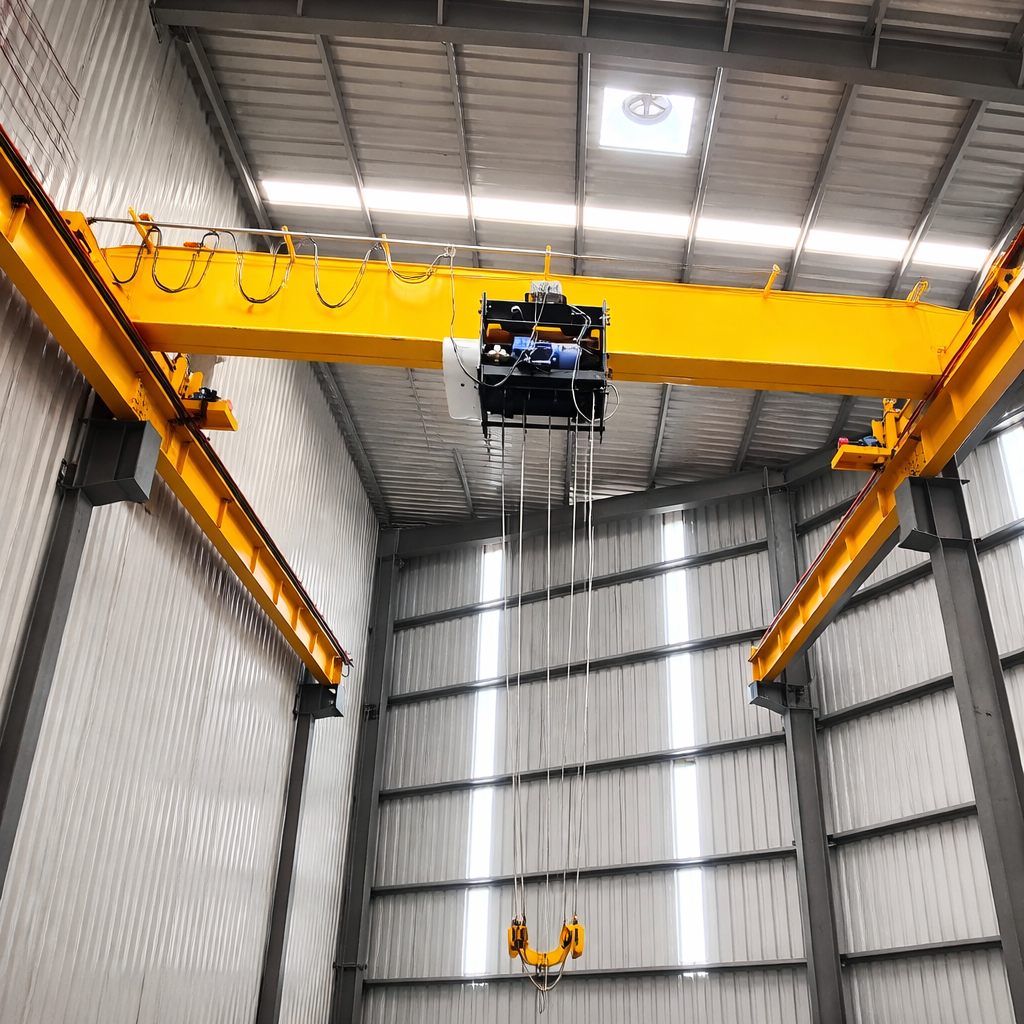
Single Beam Overhead Crane
Single Beam Overhead Crane
Expert single beam overhead crane solutions in Ahmedabad. Hindustan Cranes offers reliable, efficient, and custom-engineered lifting equipment.
What is a Single Beam Overhead Crane? — Overview
A single beam overhead crane, often referred to as a Single Girder EOT (Electric Overhead Traveling) crane, is a type of industrial crane that utilizes a single main bridge girder to support the hoist. The hoist unit travels along the bottom flange of this single girder. The entire bridge assembly moves horizontally along elevated runways, typically mounted on the building's support columns. This design makes them a popular choice for applications requiring lifting capacities that don't necessitate the heavier-duty construction of a double girder crane. They are electrically powered and operated, offering precise control over lifting and movement.
Key Features and Technical Specifications
- Single Girder Design: Utilizes one main beam for load suspension, offering a lighter and often more cost-effective solution.
- Robust Hoist Unit: Equipped with a high-quality electric wire rope hoist or chain hoist for reliable lifting.
- Precise Travel Control: Variable Frequency Drive (VFD) options for smooth and controlled cross-travel and long-travel movements.
- Durable Construction: Fabricated from high-grade steel for longevity and resistance to industrial wear and tear.
- Adjustable Span and Height: Can be customized to fit specific workshop dimensions and lifting height requirements.
- Safety Features: Includes overload protection, limit switches, emergency stop buttons, and robust braking systems.
- Modular Design: Facilitates easier installation, maintenance, and potential future upgrades.
- Low Headroom Options: Available in configurations designed to maximize vertical lifting space within facilities with limited clearance.
Industrial Applications and Use Cases
- Manufacturing Workshops: Ideal for lifting components, tools, and finished products within assembly lines.
- Fabrication Shops: Used for positioning heavy metal parts during welding, cutting, and assembly processes.
- Warehousing and Logistics: Efficiently moving pallets, crates, and bulk materials for storage and retrieval.
- Automotive Industry: Essential for handling engines, chassis components, and assembly line tasks.
- Light to Medium Duty Foundries: Transferring molds, ladles, and castings.
- Machine Shops: Lifting heavy machinery, dies, and workpieces for setup and maintenance.
- General Assembly Areas: Providing flexible lifting support across various production stages.
- Maintenance Bays: Facilitating the lifting and positioning of equipment for repair and servicing.
How to Choose the Right Single Beam Overhead Crane
Selecting the appropriate single beam overhead crane involves careful consideration of your specific operational needs. A thorough assessment will ensure you invest in a solution that enhances efficiency without compromising safety or budget.
- Load Capacity: Determine the maximum weight you need to lift, considering both current and potential future requirements.
- Span and Reach: Measure the distance between your runway beams and the desired working area to ensure adequate coverage.
- Lifting Height: Calculate the required hook height, accounting for the load, the hoist, and any headroom limitations.
- Duty Cycle: Assess how frequently and for how long the crane will be in operation to select a motor and hoist suitable for the workload.
- Power Source and Controls: Consider the available electrical supply and the preferred control method (e.g., pendant, radio remote).
- Environmental Conditions: Evaluate factors like dust, humidity, temperature, and corrosive elements that might affect crane components.
- Manufacturer's Reputation and Support: Research suppliers for their experience, quality of manufacturing, and availability of after-sales service.
- Compliance and Certifications: Ensure the crane meets relevant industry standards and safety regulations.
Quality Standards and Compliance
When procuring a single beam overhead crane, verifying adherence to established quality standards and compliance regulations is non-negotiable. These standards ensure the equipment is designed, manufactured, and tested for safety and reliability. Key certifications and standards to look for include those set by the Bureau of Indian Standards (BIS) for lifting equipment, and international standards like ISO for quality management systems. Reputable manufacturers will often comply with relevant IS standards for structural integrity, electrical safety, and operational performance. Always inquire about the specific standards the crane meets and request documentation to confirm compliance.
Why Hindustan Cranes' Experience and Capability Matters
At Hindustan Cranes & Hoist Co., our extensive experience in designing and manufacturing single beam overhead cranes for diverse industrial applications in Ahmedabad and beyond sets us apart. With over 15 years in the industry, we possess a deep understanding of the unique challenges faced by businesses in this region. Our manufacturing process is driven by precision engineering, utilizing high-quality materials and adhering to stringent quality control measures at every stage. Our team of experienced engineers and technicians ensures that each crane is not only built to last but also optimized for performance and safety.
We pride ourselves on our ability to provide customized solutions, working closely with clients to understand their specific operational needs and tailor cranes accordingly. This collaborative approach, combined with our commitment to reliable delivery and comprehensive after-sales support, ensures that our clients receive lifting solutions that truly enhance their productivity and operational efficiency. Our track record of successful projects and satisfied clients is a testament to our capability and dedication to engineering excellence.
Installation, Maintenance, and Care Tips
Proper installation and regular maintenance are crucial for the safe and efficient operation of your single beam overhead crane. Upon delivery, ensure installation is carried out by qualified technicians who understand the specific requirements of your facility and the crane's design. This includes correct mounting of runway beams, electrical connections, and initial testing.
For ongoing maintenance, establish a routine inspection schedule. This should include checking the hoist rope for wear, inspecting brakes and electrical components, lubricating moving parts, and verifying the integrity of the structure. Regular cleaning of the crane, especially in dusty environments, can prevent premature wear on components. Always follow the manufacturer's recommended maintenance schedule and use genuine spare parts to ensure longevity and prevent unexpected downtime.
Frequently Asked Questions
The main advantage is its lighter construction and often lower cost, making it a more economical choice for applications with moderate lifting requirements and where space or building load capacity might be a concern.
The duty cycle indicates how often and for how long the crane will be used. A higher duty cycle requires more robust motors, brakes, and structural components to withstand continuous operation and prevent overheating or premature wear.
While primarily designed for indoor use, some single beam overhead cranes can be adapted for outdoor applications with appropriate weatherproofing, corrosion protection, and specialized controls. However, gantry cranes are generally more suited for outdoor operations.
Standard safety features include overload protection devices, limit switches to prevent over-travel, emergency stop buttons, audible and visual warning signals, and reliable braking systems for both the hoist and travel motions.
The span is the horizontal distance between the centers of the two runway beams on which the crane travels. It is determined by the dimensions of your facility and the specific area you need the crane to cover.
Regular maintenance includes visual inspections of the structure, hoist, brakes, and electrical components, lubrication of moving parts, testing of safety features, and periodic professional servicing as recommended by the manufacturer.
Conclusion
For industries in Ahmedabad seeking efficient, reliable, and cost-effective material handling solutions, the single beam overhead crane offers a compelling option. Its versatility, combined with a well-engineered design, makes it an indispensable tool for boosting productivity and ensuring operational safety across a wide range of applications. Choosing a reputable manufacturer like Hindustan Cranes & Hoist Co., with a proven track record, deep technical expertise, and a commitment to quality, is crucial. By carefully considering your specific load, span, and operational requirements, and partnering with an experienced provider, you can implement a lifting solution that supports your business growth and operational excellence for years to come.
Get In Touch
Hindustan Cranes & Hoist Co